Little Bit of Gore
Sound design, implementation & music · 2024 · Matthew Ganther
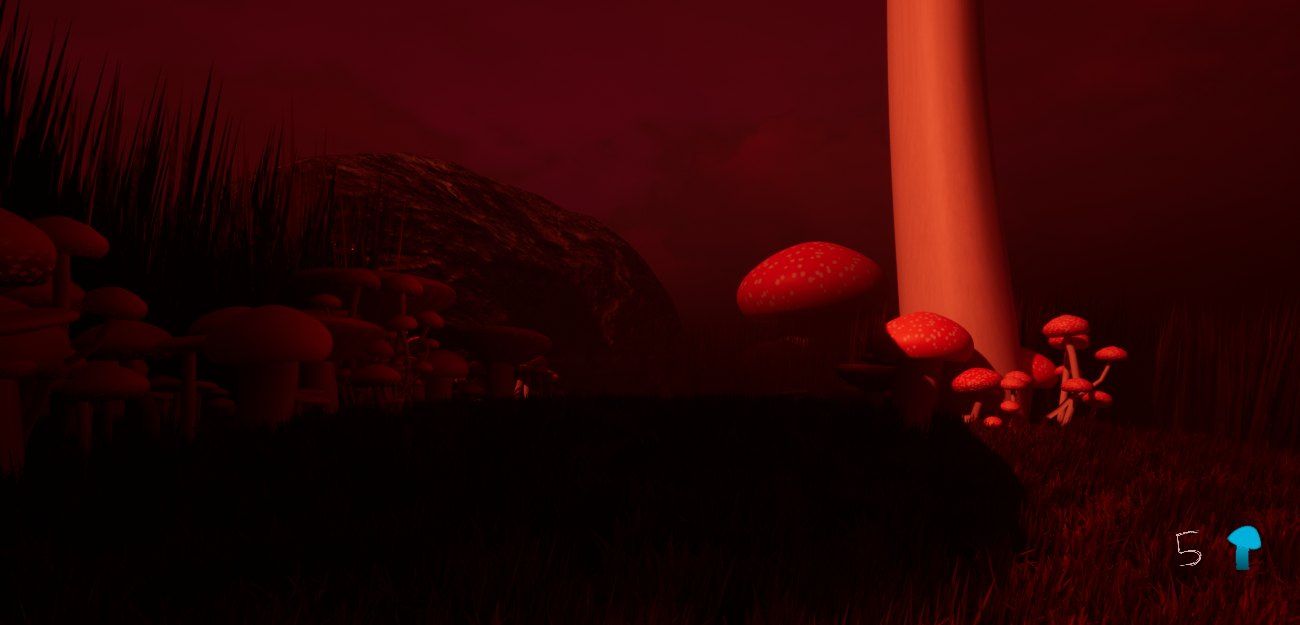
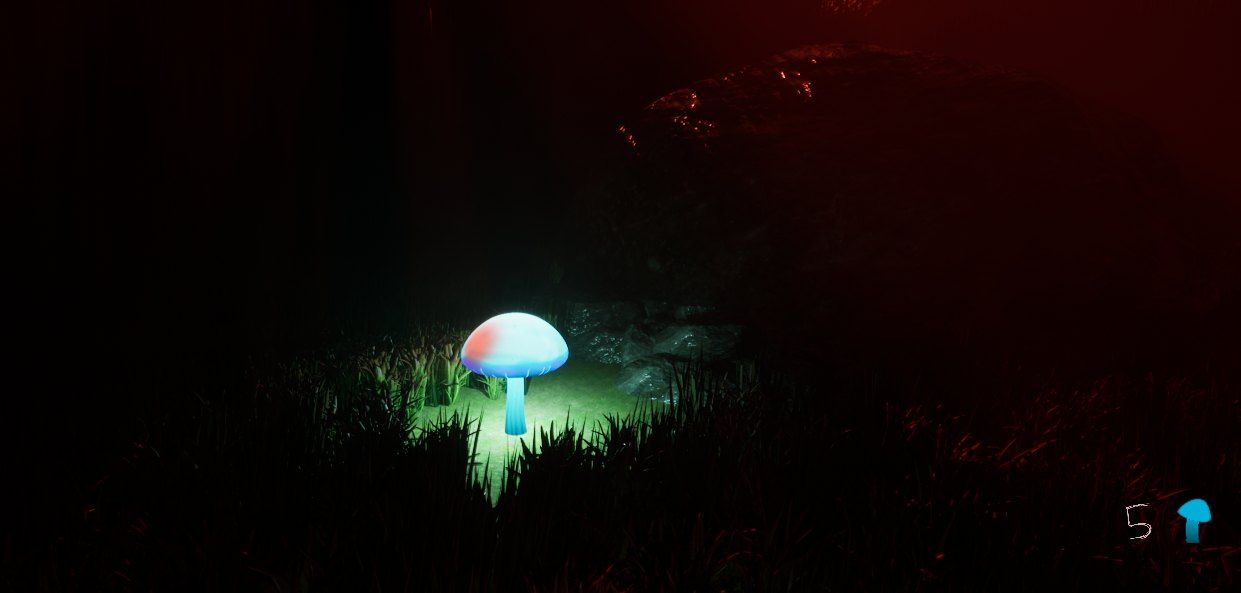
Little Bit of Gore is a short first-person survival horror game by Matthew Ganther. You’re a tiny mushroom, newly sprouted into a world drowned in gore, and you have to find five glowing mushrooms while mutated bugs hunt you through the long grass.
Hearing the monsters is how you stay alive, so the sound is a big part of how the game plays. I designed and implemented its sound effects, ambience and music in FMOD and Unreal Engine 5, in collaboration with fellow student Ryan Zibell, who did the sound for the intro animation. I made all of it on nothing but my high-school Lenovo ThinkPad and a pair of headphones.

What I did
- Audio occlusion, with ray tracing: a monster behind a wall or a row of crops is muffled and turned down, so you can tell where it really is
- A sound for each monster that tells you where it is and what it’s about to do
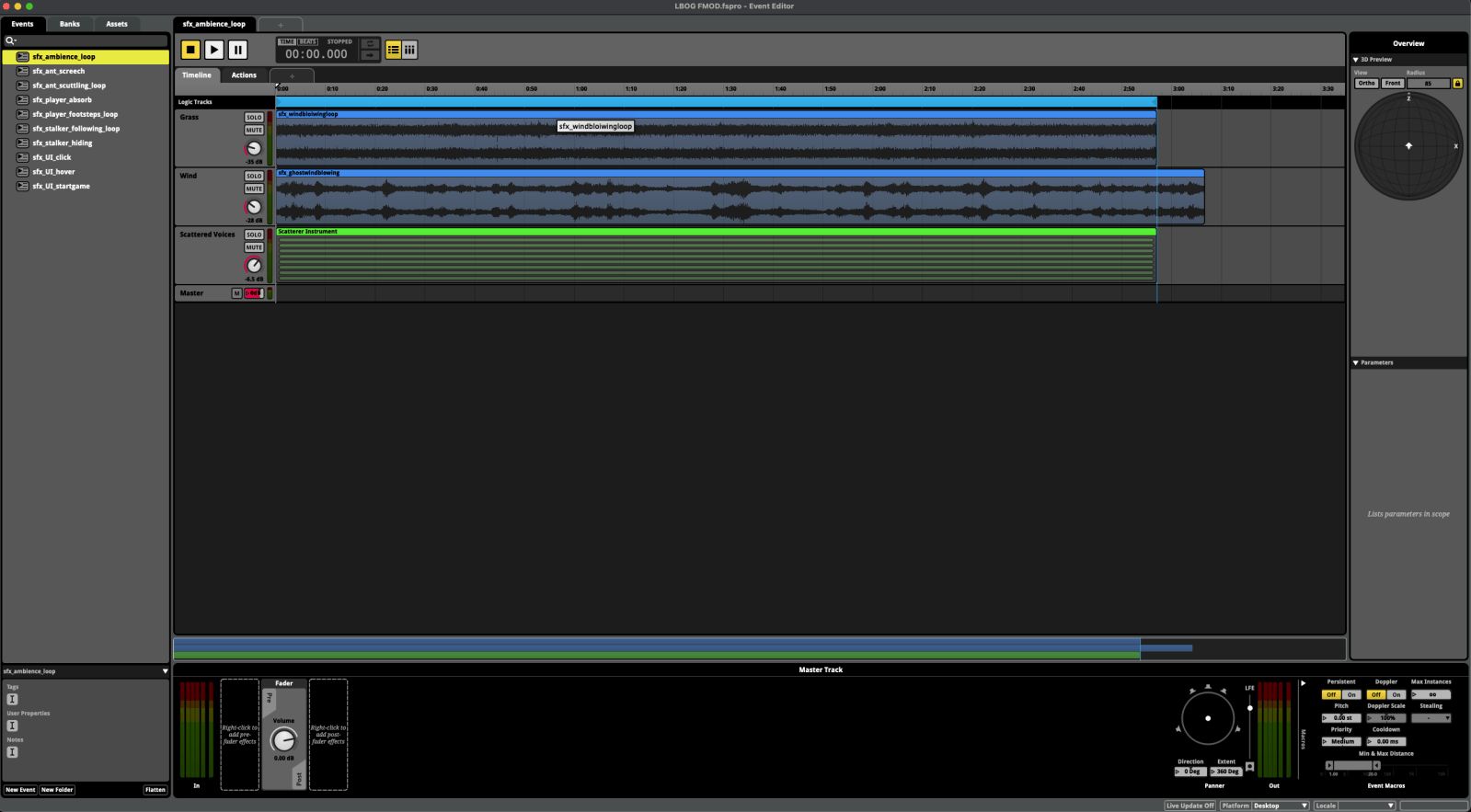
- An adaptive score in four layers, and a three-layer ambience
- Footsteps, the menus and the intro screen
- Implementation in FMOD Studio and Unreal Engine 5.1
The monsters
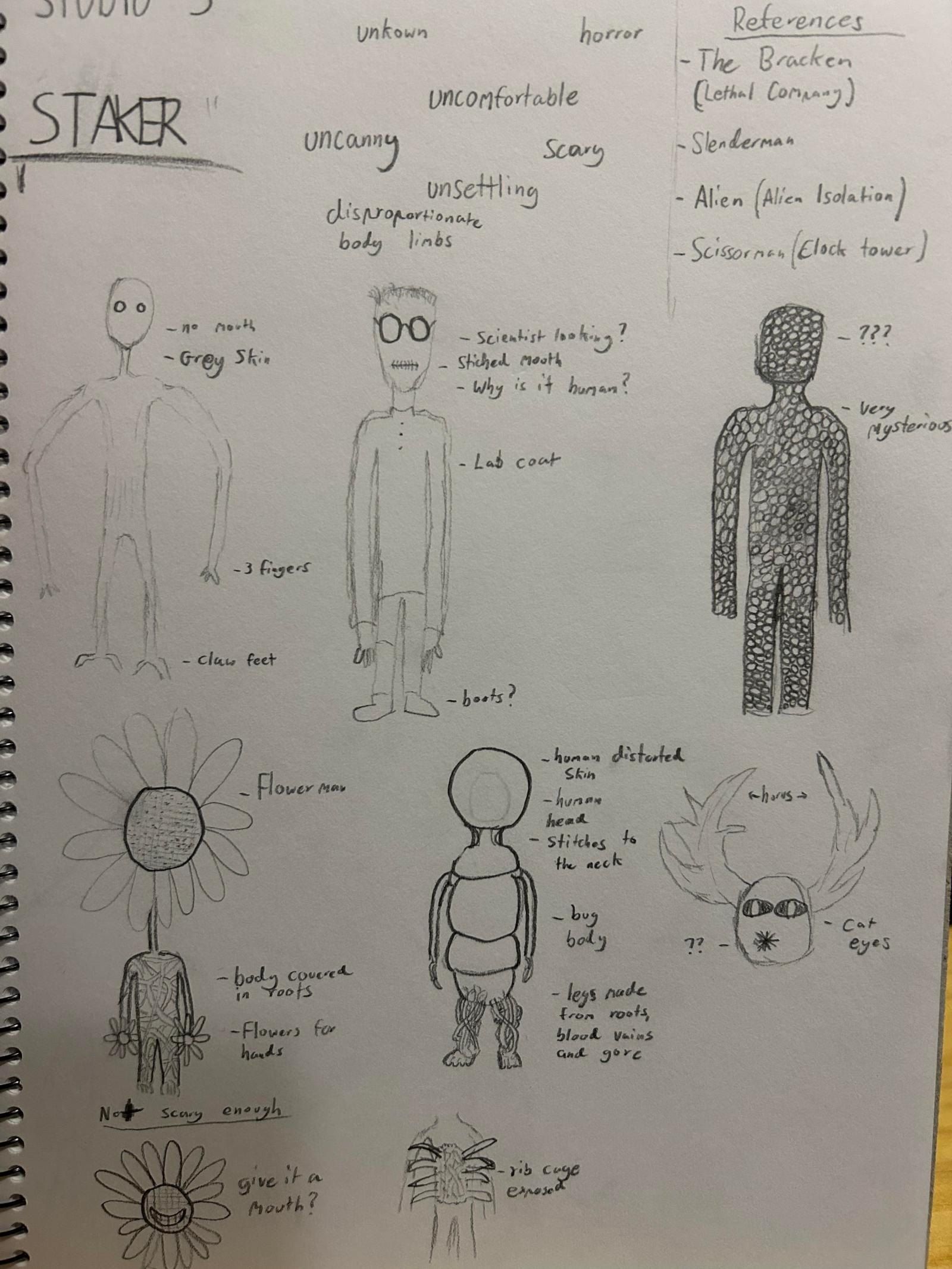
- Stalker follows you and strikes when its time runs out, unless you turn and look at it. Its breathing is me bowing metal rulers, layered with my own wails and a low hum. A tremolo speeds up as it gets ready to strike, so you can hear when to turn around. Its whispers are four reversed takes of me whispering “s”, drowned in reverb and reverse delay.
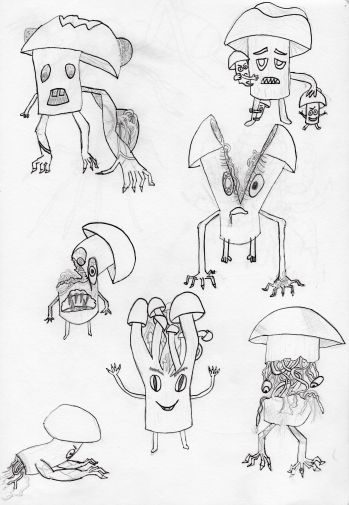
- The Bug Monstrosity hunts you down like a Pac-Man ghost, so it’s loud and repetitive: easy to track, and to avoid.
- The Infected Mushroom charges in bursts, then sleeps. Its footsteps are boosted hard in the sub-bass, with more reverb the further away it is, so you feel it coming.
- The Ants scuttle about and shriek when you get too close.
Occlusion and intensity
Because you find the monsters by ear, the most important system is the occlusion. Rays are traced from the player to each monster as you move; when one hits a wall or a row of crops on the way, that monster’s sound is muffled with a low-pass filter and turned down. So a monster that sounds close and clear really is in the open, and one that sounds dull is behind something.
A second system raises the intensity of the music and ambience as you collect mushrooms. The footsteps are me stepping in a bucket of soil, cut into a seamless loop.

Music and ambience
The score is an ambient horror piece in four layers. The first three build as you collect mushrooms; the fourth comes in when the Infected Mushroom or the Bug Monstrosity gets close. Underneath, the ambience has three layers of its own: soft wind through the crops, a howling wind, and a distant, echoing voice every 30 to 90 seconds, a hint that something much bigger is out there.

Behind the scenes
Documentation footage, the Apprehension Engine, and the full Blueprint breakdown


Project details
| Game | First-person survival horror |
|---|---|
| Engine | Unreal Engine 5.1 |
| Audio middleware | FMOD Studio |
| DAW | Reaper |
| Version control | Git |
| Team | Matthew Ganther (development); me (sound effects, music, implementation); Ryan Zibell (intro animation sound) |
| Timeframe | March to June 2024 |
| Platform | Windows, on itch.io |